Accelerating early-stage drug discovery at low-cost with AI
The journey of drug discovery is a winding, often frustrating road defined by risk, long timelines, and staggering costs. A typical pharmaceutical company spends up to $2 billion and more than 15 years from the discovery of a drug target to an approved treatment. The high costs involved in early-stage drug discovery – the process of finding potential drug candidates – are especially frustrating & daunting.
This was the spark for Klyne AI. CEO Zachary Lawrence comes with a background in mathematics and computer science. He also led investments within the biotech and drug discovery sectors. The challenges of high-risk investments and slow, expensive drug development cycles led to a crucial realization: early-stage drug discovery needed a technological overhaul.
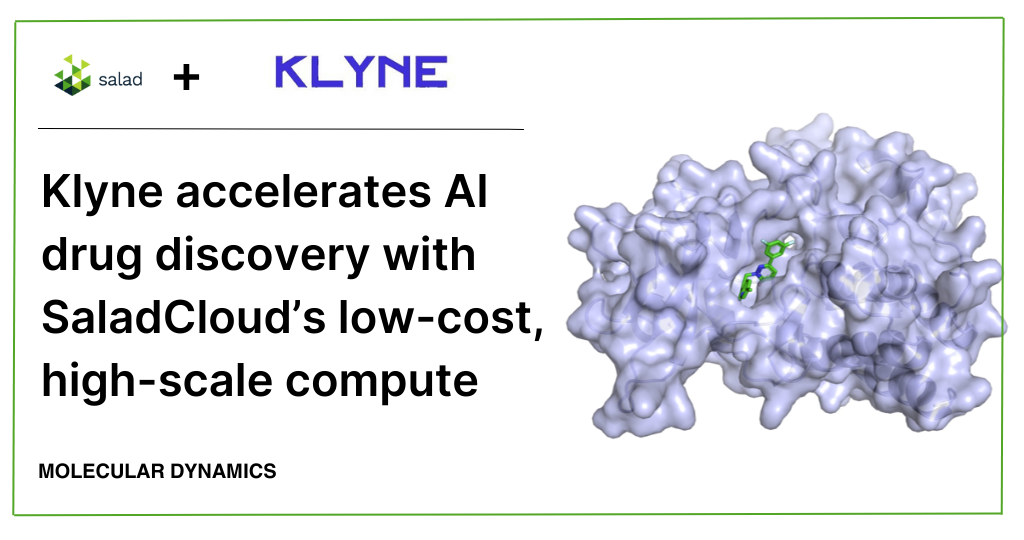
Klyne was born in late 2023 to fix this – to help accelerate early-stage drug discovery at low-cost with AI-powered software that improves the efficiency of finding novel hits and optimizing them.
“We help smaller companies and startups go from spending hundreds of thousands of dollars to just tens of thousands of dollars – an order of magnitude difference”, says Zack.
Klyne’s USP: Proprietary AI model. Pay-go business model.
Klyne’s USP lies in their proprietary AI models, including the SPARC model, designed to predict binding affinity — a key measure of how well a drug will interact with a target protein. Klyne’s machine learning-driven predictions are as accurate as anything currently available. They also demand just 1% of the total compute power compared industry standard approaches. This was made possible by the construction of a large proprietary training dataset.
There’s another model in Klyne’s arsenal that gives them an advantage: their business model. Rather than charging high upfront subscription fees, Klyne offers pay-as-you-go services and software licenses, democratizing access to advanced drug discovery tools for startups and small businesses.
Companies can provide Klyne with a protein file, and their software will analyze trillions of compounds to deliver a list of chemical structures that are very likely to bind to the protein. Since many companies do not have in silico drug discovery expertise in-house, most companies elect to use their white-glove service to ensure the discovery pipeline is set-up in the most optimal way.
The challenge in scaling computational resources for drug discovery
However, like many startups in the biotech and life sciences space, Klyne faced significant challenges in scaling their operations, particularly around the high computational costs and burst GPU requirements associated with molecular dynamics (MD) simulations.
Zack adds, “We needed massive amounts of low-cost compute resources to run 100s of thousands of molecular dynamics simulations. Even with the most efficient algorithms, these simulations are slow, lengthy, and expensive to run. It’s crucial to have as many GPUs as possible at the cheapest price.”
Traditional cloud providers offered expensive, high-performance GPUs – ideal for AI training, but are not cost-effective of molecular dynamics simulations. Klyne’s GPU needs varied from tens to hundreds to thousands, which made scaling on hyperscalers prohibitively expensive and challenging.
This is where SaladCloud’s flexible, cost-effective cloud computing services became an essential part of Klyne’s success.
“You don’t really want higher-end GPUs for your MD simulations. Other cloud providers are focused on providing high-end GPUs. But molecular dynamics is a different market with different needs. SaladCloud’s lower-end GPUs offer way better cost-efficiency for MD simulations”
“We may ramp up to 10,000 simulations and ramp down quickly and often. So renting
Zachary Lawrence, CEO of Klyne AI
GPUs wasn’t an option. Spot pricing on GCP/AWS is so much more expensive for
molecular dynamics simulations than SaladCloud. Plus they don’t always have
availability of 1000s of GPUs. With SaladCloud, we can scale up to 1000s of GPUs
quickly saving at least 50% compared to other alternatives.”
SaladCloud helps Klyne scale fast at a low-cost on consumer GPUs
While traditional cloud providers offered high-end GPUs, SaladCloud’s distributed infrastructure is tailored to fit the specific needs of drug discovery simulations – allowing companies like Klyne access to 1000s of consumer GPUs at the lowest market cost.
“We may ramp up to 10,000 simulations and ramp down quickly and often. So renting GPUs wasn’t an option. Spot pricing on GCP/AWS is so much more expensive for molecular dynamics simulations than SaladCloud. Plus they don’t always have availability of 1000s of GPUs. With SaladCloud, we can scale up to 1000s of GPUs quickly saving at least 50% compared to other alternatives”, added Zack. “The downside of interruptible instances do exist but can be overcome with specific code to save snapshots”.
Whether it’s running thousands of simulations or conducting a more targeted molecular dynamics simulation, Salad’s flexibility has been a game-changer for Klyne’s business.
“Salad’s team has been a valuable partner for us, building Kelpie for our batch needs and being really customer friendly. We can directly connect with Salad’s engineering team and get the kind of support we wouldn’t from a bigger cloud provider”, adds Zack.
The future of AI drug discovery: Klyne, SaladCloud, and beyond
Like any AI startup, Klyne has faced infrastructure challenges along the way. The transition from traditional infrastructure to distributed cloud computing was a learning curve. Salad’s support team worked directly with Klyne to develop best practices for running molecular dynamics simulations at low-cost and high-scale on a distributed cloud.
By enabling companies to predict drug affinity early in the process and reduce reliance on costly experimental testing, Klyne is helping to make the entire process more efficient and cost-effective. Their platform is used by a range of clients—from academic researchers at universities to enterprise-level drug discovery teams at large pharma companies.
“We’re creating the next wave of drug discovery software,” said the Klyne founder. “And SaladCloud is helping us get there faster.”

SaladCloud is the world’s largest distributed cloud computing network with 11,000+ daily GPUs and 450,000 GPUs contributing compute, all at the lowest cost in the market.