Analyzing the Stunning Realism of GTA6 with YOLOv8 and SaladCloud
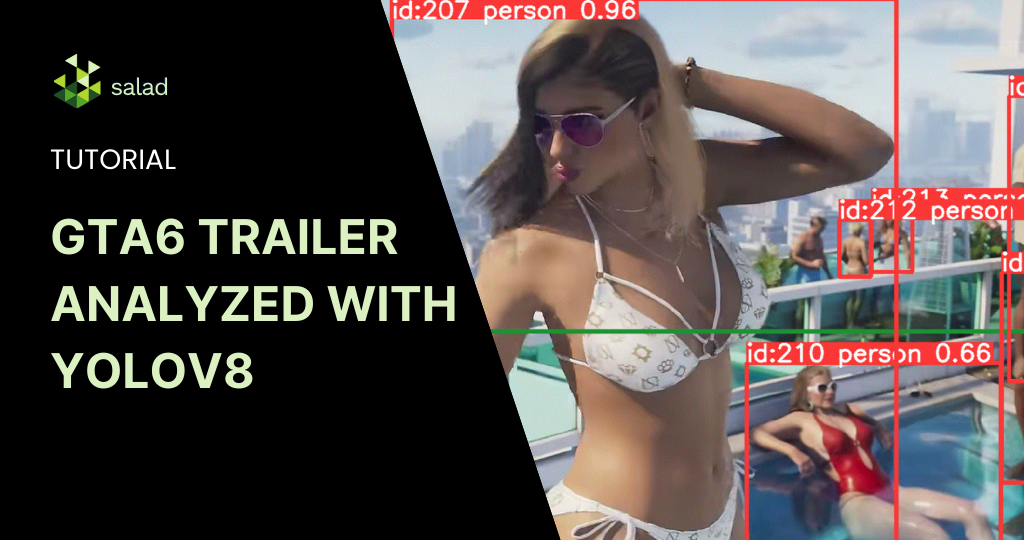
Running YOLOv8 on the GTA6 trailer with SaladCloud The gaming community was recently electrified with the release of a new trailer for “Grand Theft Auto VI” (GTA6), a title known for its immersive gameplay and hyper-realistic graphics. To gauge the level of detail and realism in the game’s graphics, we conducted an interesting experiment: we ran the trailer through the YOLOv8 model, a cutting-edge object detection AI hosted on SaladCloud for this experiment. The results were nothing short of fascinating, providing a glimpse into the intricate world that GTA6 promises to offer. YOLO (You Only Look Once) models are renowned for their efficiency and accuracy in detecting objects in images and videos. We chose YOLOv8 for its latest advancements in machine learning and its ability to discern objects with high precision. We picked a medium pre-trained model provided by Ultralytics: “yolov8m.pt”. To facilitate this experiment, we utilized SaladCloud, the most affordable GPU compute platform available today. We created an API that, upon receiving the URL and storage information, processed the video through the YOLOv8 model and saved all detections to our storage account. Additionally, it generated a summary detailing the duration each object was present in the video. For those interested in the technical details or in replicating this experiment, we have prepared a comprehensive YOLOv8 tutorial available on SaladCloud’s documentation: YOLOv8 Deployment Tutorial. Our computational setup for this experiment included 8 vCPUs, 8GB of memory, and an RTX 3090 GPU with 24 GB of VRAM. Remarkably, this configuration is priced at only $0.29 per hour on SaladCloud. Results from the object detection experiment The entire process of running the video through the model and saving the results took approximately 90 seconds. This translates to a very cost-effective operation. To calculate the exact cost: Total time: 90 seconds (or 1.5 minutes)Hourly rate: $0.29Cost for 1.5 minutes: (1.5×0.29)/60 = $0.0072 Let’s compute the exact cost for this operation.The cost of running the video through the model on SaladCloud for 1.5 minutes came to approximately $0.0072 which is approximately 0.73 cents. This exceptionally low cost demonstrates the efficiency and affordability of using SaladCloud for high-end GPU compute tasks. Let’s check our results now. The model easily detected and tracked the main characters, especially when they were the central figures in a scene. What is more impressive is how the model performed detecting NPCs in the bustling scenes set on the beaches of Vice City, even amidst massive crowds. This level of accuracy is crucial for understanding the dynamics of densely populated game environments, a staple in the GTA series. Another area where YOLOv8 excelled was in identifying various modes of transportation that are central to the GTA experience, such as motorcycles, cars, and boats. The accuracy in this domain is essential, given the franchise’s emphasis on vehicular exploration and interaction. However, the model wasn’t flawless. In some instances, it confused birds with kites, likely due to their similar appearance in motion. A gator from one of the scenes was mistaken with a dog, probably because the gator is not a part of the labels in the pre-trained model. The model’s performance in analyzing aerial shots or bird’s-eye views of the city was also noteworthy. Capturing details from such perspectives can be challenging due to changes in scale and perspective, yet YOLOv8 managed to do a commendable job. Perhaps one of the most striking demonstrations of the model’s capabilities was its detection of little details, such as bottles on the shelves in a shop scene. Here is a count of all the unique objects our solution detected in the trailer: OBJECT IN GTA6 TRAILER COUNT PERSON 133 CAR 65 BIRD 23 BOTTLE 16 KITE 15 TRUCK 9 MOTORCYCLE 9 BOAT 8 CHAIR 7 UMBRELLA 4 BUS 3 AIRPLANE 2 SPORTS BALL, CAT, DOG, TRAFFIC LIGHT 1 Overall, the results from running the GTA6 trailer through YOLOv8 on SaladCloud illustrate the remarkable advancements in both video game graphics and AI technology. As we move forward, such synergies between AI and gaming are likely to enhance our virtual experiences, blurring the lines between the digital and real-world even further. GTA6, with its stunning graphics validated by computer vision, is poised to be more than just a game; it’s a glimpse into the future of immersive virtual experiences. What also stands out is SaladCloud’s cost-effectiveness. Running this sophisticated AI analysis costs us merely 0.73 cents, a testament to the affordability of high-end GPU capabilities for object detection. SaladCloud’s role in enabling the analysis of GTA6’s stunning graphics with YOLOv8’s precision at such a low cost highlights the growing accessibility of advanced technology like computer vision in gaming and AI. This synergy is not just pushing the boundaries of virtual experiences but also making them more attainable, heralding a future where such advancements are within reach of a wider audience. SaladCloudSaladCloud is the world’s largest distributed cloud computing network with 11,000+ daily GPUs and 450,000 GPUs contributing compute, all at the lowest cost in the market.
Training a custom YOLOv8 model on SaladCloud for just $0.25

Training a Custom YOLOv8 Model for Logo Detection In the dynamic world of AI and machine learning, the ability to customize is immensely powerful. Our previous exploration delved into deploying a pre-trained YOLOv8 model using Salad’s cloud infrastructure, revealing 73% cost savings in real-time object tracking and analysis. Advancing this journey, we’re now focusing on training a customized YOLO (You Only Look Once) model using SaladCloud’s distributed infrastructure. In this training, we focused on processing times, cost efficiency, and model accuracy – things that are relevant to real-world use-case scenarios. Training custom models is notably more resource-intensive than running pre-trained ones. It demands substantial GPU power and time, translating into higher costs. This is especially true for deep learning models used in object detection, where numerous parameters are fine-tuned over extensive datasets. The process involves repeatedly processing large amounts of data, making heavy use of GPU resources forextended periods. Here are some of our considerations for this training: Dataset and Preparation For our testing, we decided to create a custom model that will be able to detect popular logos. Training Approach SaladCloud’s Role in Streamlining Training Training Results Overview: Cost-Effectiveness and Performance of YOLOv8 Models As we delve into the world of custom model training, it’s crucial to evaluate both the financial and performance aspects of the models we train. Here, we provide a concise comparison of the YOLOv8 Nano, Small, and Medium models, highlighting their training duration and associated costs when trained on SaladCloud, a platform celebrated for its efficiency and cost-effectiveness.First, let’s check performance differences based on validation results: It seems like every next model is slightly better than the previous one. Let us check how long it took to train each model and how much was spent using SaladCloud: Each model brings unique strengths to the table, with the Nano model offering speed and cost savings, while the Medium model showcases the best performance for more intensive applications. That is unbelievable that we got a performing custom detection model for only 25 cents. Bringing Custom Models to Life: Tracking Coca-Cola Labels With our custom-trained YOLO model in hand, we now want to test it in the real life. We will run a logo tracking experiment on the iconic Coca-Cola Christmas commercial. This real-world application illustrates the practical utility of our model in dynamic, visually-rich scenarios.For those eager to replicate this process or deploy their own models for similar tasks, detailed instructions are available in our previous article, which walks you through the steps of running inference on Salad’s cloud platform.Let’s now see the performance of our YOLO model in action and witness how it keeps up with the holiday spirit, frame by frame: As a result we can see that we not only can use our custom trained model on images, but even on videos adding tracking possibilities. Conclusion: An Extremely Affordable Path to Custom Model Training By harnessing the power of SaladCloud, we managed to train three distinct YOLO models, each tailored to the same dataset and unified by consistent hyperparameters. The training took under an hour at the economical sum of 1 dollar. The culmination of this process is a robust model fine-tuned for real-world applications, remarkably realized at the modest expense of a quarter. This endeavor not only highlights the feasibility of developing custom AI solutions on a budget but also showcases the potential for such models to be rapidly deployed and iteratively improved in commercial and research settings. SaladCloudSaladCloud is the world’s largest distributed cloud computing network with 11,000+ daily GPUs and 450,000 GPUs contributing compute, all at the lowest cost in the market.
YOLOv8 Benchmark: Object Detection on SaladCloud’s GPUs (73% Cheaper Than Azure)
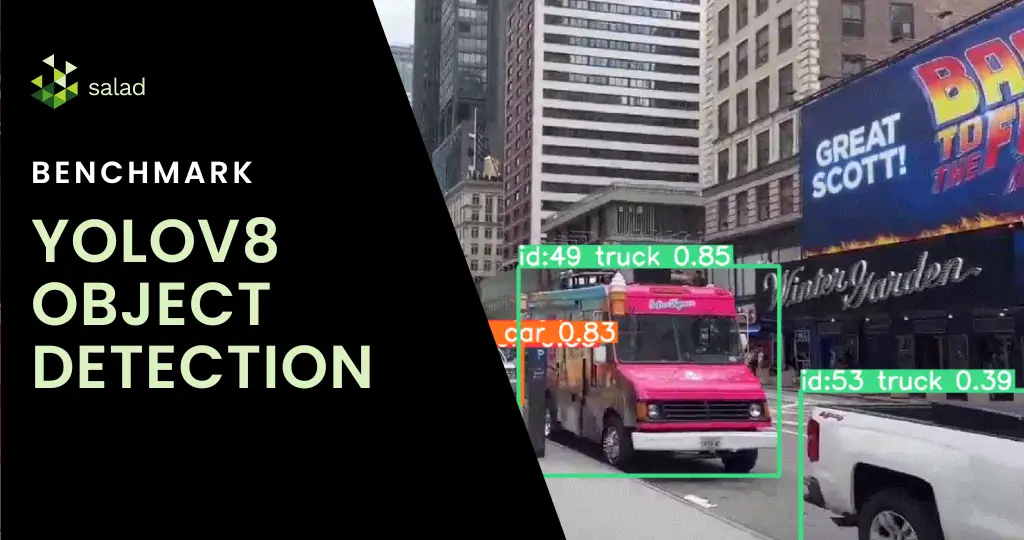
What is YOLOv8? In the fast-evolving world of AI, object detection has made remarkable strides, epitomized by YOLOv8. YOLO (You Only Look Once) is an object detection and image segmentation model launched in 2015, and YOLOv8s is the latest version, which was developed by Ultralytics. The algorithm is not just about recognizing objects; it’s about doing so in real time with unparalleled precision and speed. From monitoring fast-paced sports events to overseeing production lines, YOLOv8 is transforming how we see and interact with moving images. With features like spatial attention, feature fusion, and context aggregation modules, YOLOv8 is being used extensively in agriculture, healthcare, and manufacturing, among others. In this YOLOv8 benchmark, we compare the cost of running YOLO on SaladCloud and Azure. Running object detection on SaladCloud’s GPUs: A fantastic combination YOLOv8 can be run on GPUs as long as they have enough memory and support CUDA. But with the GPU shortage and high cost, you need GPUs rented at affordable prices to make the economics work. SaladCloud’s network of 10,000+ Nvidia consumer GPUs has the lowest prices in the market and is a perfect fit for YOLOv8. Deploying YOLOv8 on SaladCloud democratizes high-end object detection, offering it a scalable, cost-effective cloud platform for mainstream use. With GPUs starting at $0.02/hour, SaladCloud offers businesses and developers an affordable, scalable solution for sophisticated object detection at scale. A deep dive into live stream video analysis with YOLOv8 This benchmark harnesses YOLOv8 to analyze not only pre-recorded but also live video streams. The process begins by capturing a live stream link, followed by real-time object detection and tracking. Using GPU’s on Saladcloud, we can process each video frame in less then 10 milliseconds, which is 10 times faster then using a CPU. Each frame’s data is meticulously compiled, yielding a detailed dataset that provides timestamps, classifications, and other critical metadata. As a result, we get a nice summary of all the objects present in our video: How to run YOLOv8 on SaladCloud’s GPUs We introduced a FastAPI with a dual role: it processes video streams in real time and offers interactive documentation via Swagger UI. You can process live streams from YouTube, RTSP, RTMP, and TCP, as well as regular videos. All the results will be saved in an Azure storage account you specify. All you need to do is send an API call with the video link, check if the video is a live stream or not, and store account information and timeframes of how often you want to save the results. We also integrated multithreading capabilities, allowing multiple video streams to be processed simultaneously. Deploying on SaladCloud In our step-by-step guide, you can go through the full deployment journey on SaladCloud. We configured container groups, set up efficient networking, and ensured secure access. Deploying the FastAPI application on SaladCloud proved to be not just technically feasible but also cost-effective, highlighting the platform’s efficiency. Price comparison: Processing live streams and videos on Azure and SaladCloud When it comes to deploying object detection models, especially for tasks like processing live streams and videos, understanding the cost implications of different cloud services is crucial. Let’s do some price comparison for our live stream object detection project: Context and Considerations Live Stream Processing: Live streams are unique in that they can only be processed as the data is received. Even with the best GPUs, the processing is limited to the current feed rate. Azure’s Real-Time Endpoint: We assume the use of an ML Studio real-time endpoint in Azure for a fair comparison. This setup aligns with a synchronous process that doesn’t require a fully dedicated VM. Azure Pricing Overview We will now compare the compute prices in Azure and SaladCloud. Note that in Azure you can not pick RAM, vCpu and GPU memory separately. You can only pick preconfigured computes. With SaladCloud, you can pick exactly what you need. Lowest GPU Compute in Azure: For our price comparison, we’ll start by looking at Azure’s lowest GPU compute price, keeping in mind the closest model to our solution is YOLOv5. 1. Processing a Live Stream Service Configuration Cost per hour Remarks Azure 4 core, 16GB RAM (No GPU) $0.19 General purpose compute, no dedicated GPU SaladCloud 4 vCores, 16GB RAM $0.032 Equivalent to Azure’s general compute Percentage Cost Difference for General Compute SaladCloud is approximately 83% cheaper than Azure for general compute configurations. 2. Processing with GPU Support. This is the GPU Azure recommends for yolov5. Service Configuration Cost per hour Remarks Azure NC16as_T4_v3 (16 vCPU, 110GB RAM, 1 GPU) $1.20 Recommended for YOLOv5 SaladCloud Equivalent GPU Configuration $0.326 SaladCloud’s equivalent GPU offering Percentage Cost Difference for GPU Compute SaladCloud is approximately 73% cheaper than Azure for similar GPU configurations. YOLOv8 deployment on GPUs in just a few clicks You can deploy YOLOv8 in production on SaladCloud’s GPUs in just a few clicks. Simply download the code from our GitHub repository or pull our ready-to-deploy Docker container from the SaladCloud Portal. It’s as straightforward as it sounds – download, deploy, and you’re on your way to exploring the capabilities of YOLOv8 in real-world scenarios. Check out SaladCloud documentation for quick guides on how to start using our batch or synchronous solutions. Check out our step-by-step guide To get a comprehensive step-by-step guide on how to deploy YOLOv8 on SaladCloud, check out our step-by-step guide here. In this guide, we will show: This process is fully customizable to your needs. Follow along, make modifications, and experiment to your heart’s content. Our guide is designed to be flexible, allowing you to adjust and enhance the deployment of YOLOv8 according to your project requirements or curiosity. We are excited about the potential enhancements and extensions of this project. Future considerations include broadening cloud integrations, delving into custom model training, and exploring batch processing capabilities. SaladCloudSaladCloud is the world’s largest distributed cloud computing network with 11,000+ daily GPUs and 450,000 GPUs contributing compute, all at the lowest cost in the market.
Announcing Salad’s SOC 2 Type 1 Certification
We are pleased to announce that Salad Technologies is now SOC 2 Type I Compliant, reinforcing our commitment to democratize the cloud while ensuring the highest standards of security & compliance. This certification is in accordance with American Institute of Certified Public Accountants (AICPA) standards for SOC for Service Organizations also known as SSAE 18. What is the SOC 2 Type 1 Certification? The SOC 2 Type I certification is the first level of certification within the SOC 2 framework. It gives a snapshot assessment of an organization’s security controls at a specific point in time. SOC 2 Type I reports on the description of security & compliance controls provided by the organization and attests that the controls are suitably designed and implemented. SOC 2 Type I certification is based on five trust service principles or criteria: security, availability, processing integrity, confidentiality, and privacy. These principles define the standards for managing customer data and ensuring its protection. Why does this matter to Salad – and to our users? As the world’s largest distributed cloud, we have securely distributed business applications/workloads to anonymous hosts since 2018. With the introduction of SaladCloud to businesses in 2023, the number of B2B & B2C companies running production workloads across out network is growing tremendously. As of last count, our network welcomes more than 1 Million consumer GPUs and 100s of B2B/B2C businesses running workloads on our cloud at affordable prices. Large-scale AI image generation, voice AI, large language models (LLMs), data collection, residential IP addresses, and computer vision – the applications running on SaladCloud are growing, and so is our network of community-sourced GPUs. To protect the data and workloads of our contributors, customers and users, our team has implemented and assiduously maintains redundant security layers across our network, organization, and distributed machine environments. This certification is confirmation that our information security practices, policies, procedures, and operations meet the SOC 2 standards for security. Security is at the heart of our mission to democratize cloud computing Secure Personnel: We take the security of its data and that of its clients and customers seriously and ensure that only vetted personnel are given access to their resources. Secure Development: Our software development is conducted in line with OWASP’s Top 10 recommendations for web application security. Secure Testing: We deploy third party penetration testing and vulnerability scanning of all production and Internet facing systems on a regular basis. In addition, we also perform static and dynamic software application security testing of all code, including open source libraries. Secure Cloud: We provide maximum security on SaladCloud with complete customer isolation in a modern, multi-tenant cloud architecture. We leverage the native physical and network security features of the cloud service, and rely on the providers to maintain the infrastructure, services, and physical access policies and procedures. All customer cloud environments and data are isolated using our patented isolation approach. Each customer environment is stored within a dedicated trust zone to prevent any accidental or malicious co-mingling. All data is also encrypted at rest and in transmission to prevent any unauthorized access andprevent data breaches. Our entire platform is also continuously monitored by dedicated, highly trained experts. We separate each customer’s data and our own, utilizing unique encryption keys to ensure data is protected and isolated. Our data protection complies with SOC 2 standards to encrypt data in transit and at rest, ensuring customer and company data and sensitive information is protected at all times. We implement role-based access controls and the principles of least privileged access, and review revoke access as needed. Salad’s SOC 2 Type I Certification Salad Technologies, INC was audited by Prescient Assurance, a leader in security and compliance certifications for B2B and SAAS companies worldwide. Prescient Assurance is a registered public accounting in the US and Canada and provides risk management and assurance services, which include but are not limited to SOC 2, PCI, ISO, NIST, GDPR, CCPA, HIPAA, CSA STAR, etc. For more information about Prescient Assurance, you may reach out to them at [email protected]. To learn about trust, security & compliance on SaladCloud, visit our Trust center. SaladCloudSaladCloud is the world’s largest distributed cloud computing network with 11,000+ daily GPUs and 450,000 GPUs contributing compute, all at the lowest cost in the market.
SaladCloud Launches Kubernetes Support at KubeCon 2023
Salad is excited to announce support for Kubernetes (K8s) through the Virtual Kubelet project. The K8s integration based on the SaladCloud Virtual Kubelet Provider will be showcased at the upcoming KubeCon conference in Chicago, taking place from November 6-9, 2023. Attendees will have the opportunity to learn more about the product and its benefits firsthand by visiting Salad’s booth [E27] at KubeCon. The SaladCloud Virtual Kubelet Provider enables running K8s pods as container group deployments, unlocking a new level of flexibility and scalability for compute-hungry applications. “There is a global GPU shortage and rampant overpaying, especially for high-end, AI-focused GPUs,” said Bob Miles, CEO of Salad. “Meanwhile, millions of consumer GPUs lie unused most of the day. SaladCloud connects the two. With this K8s integration, companies with GPU-powered applications can seamlessly access Salad’s vast network of 10,000+ consumer GPUs at the lowest market price for production deployment”. Virtual Kubelet, a Cloud Native Computing Foundation (CNCF) supported project, enables organizations to extend their Kubernetes clusters by leveraging external compute resources provided by other vendors using their existing K8s control plane and the landscape of cloud native tooling. With the new SaladCloud Virtual Kubelet Provider, customers are able to deploy containerized workloads to SaladCloud, very similar to the managed computing environments offered by major cloud providers. The containerized workloads are orchestrated across a vast network of third-party, high-end gaming PCs with advanced GPU capabilities, whose suppliers receive credits to redeem for games, gift cards & other rewards. “If you don’t have enough GPUs in your data center or you’re overpaying for cloud resources, you can use SaladCloud directly from your K8s cluster with our Virtual Kubelet Provider to access affordable, on-demand, pay-per-use GPUs at massive scale”, added Kyle Dodson, Head of Engineering at Salad. “Engineering teams already building K8s apps can easily deploy to SaladCloud without changing existing development workflows.” To learn more about the SaladCloud Virtual Kubelet Provider and to request a demo, visit www.salad.com/virtualkubelet. SaladCloudSaladCloud is the world’s largest distributed cloud computing network with 11,000+ daily GPUs and 450,000 GPUs contributing compute, all at the lowest cost in the market.
A New Price-Performance Standard for BERT Transformers.
Engineers from Numenta used Salad Container Engine (SCE) to benchmark a first-of-its-kind intelligent computing platform that optimizes BERT transformer networks. Learn how Numenta attained 10x more inferences per dollar on SCE. Challenge Optimizing AI Systems Deploying practical artificial intelligence applications at scale requires the distribution of large data sets to complex networks of specialized hardware. Though deep neural networks have facilitated significant advancements, their fundamental reliance on highly available processing resources and their tendency toward rapid expansion make it costly and inefficient to run transformers in the public cloud. Price-Performance Comparison Solution Optimizing AI Systems Leveraging insights from 20 years of neuroscience research, Numenta has developed breakthrough advances in AI that deliver dramatic performance improvements across broad use cases. Grounded in the sensorimotor framework of intelligence elaborated by co-founder Jeff Hawkins in A Thousand Brains, Numenta’s innovative technology turns the principles of human learning into new architectures, data structures, and algorithms that deliver disruptive performance improvements. Case Study 10x Price Performance In a side-by-side comparison, Numenta’s optimized BERT technologies improved the throughput of a standard transformer network by up to 6.5x. When deployed on SCE, Numenta attained 10x more inferences per dollar than possible with on-demand offerings from AWS—and managed to beat the cost efficiency of the nearest spot-basis instance by 2.39x. About Numenta Numenta has developed new artificial intelligence technologies that deliver breakthrough performance in AI/ML applications such as natural language processing and computer vision. Backed by two decades of neuroscience research, Numenta’s novel architectures, data structures, and algorithms deliver disruptive performance improvements. Numenta is currently engaged in a private beta with several Global 100 companies and startups to apply its platform technology across the full spectrum of AI, from model development to deployment—and ultimately enable novel hardware architectures and whole new categories of applications. SaladCloudSaladCloud is the world’s largest distributed cloud computing network with 11,000+ daily GPUs and 450,000 GPUs contributing compute, all at the lowest cost in the market.
How Dreamup reduces AI image generation cloud cost with SaladCloud
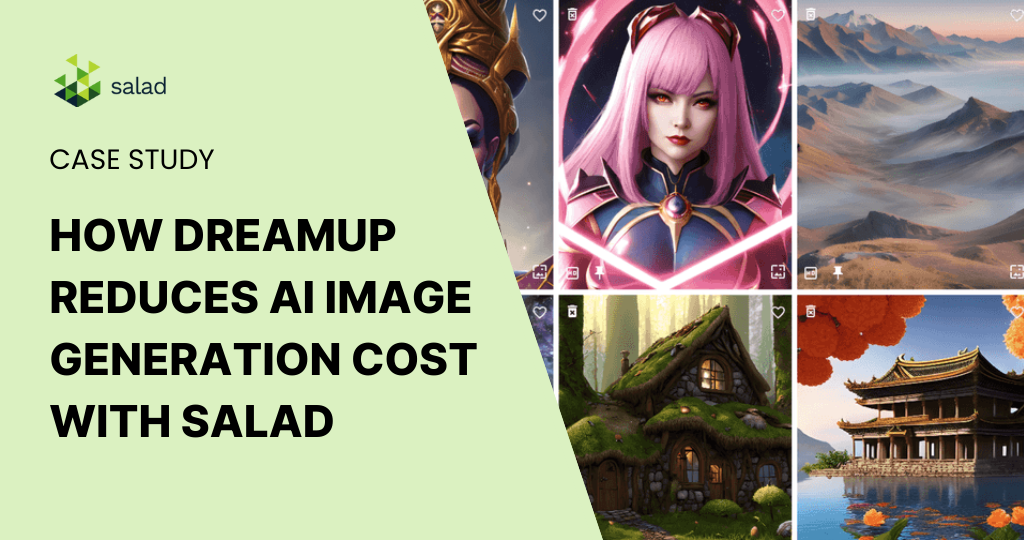
Using AI to reduce cloud costs and fund artists If you’ve spent any time on the internet in the last few months, two things will be everywhere. As with any new technology, there will always be affected parties. In Stable Diffusion’s case, it directly impacts artists by generating (incredible) art faster than the human hand can ever create. Does this mean artists will go away? Definitely not. The AI models are still trained on human-generated art (ex, image, video, voice, music, etc). There will always be a market for original art. But make no mistake – Stable Diffusion-generated art will replace a big chunk of human-generated art. Now, Shawn Rushefsky, Dreamup.ai’s founder, has set out to bridge this gap and give back to the community that’s both helped train Stable Diffusion (SD) models and is being affected by it: Artists. In founder Shawn’s words, “We are funneling money from this new controversial industry into the population that’s being affected by it”. In this interview, Shawn talks about Dreamup.ai, their use of the SaladCloud to reduce cloud cost, his motivation behind starting the company and more. Salad: What is DreamUp, and what was your motivation for starting DreamUp? Shawn: “DreamUp is a Stable Diffusion powered image-generation application that’s quickly racked up 2k+ users in 15+ countries. It originally started as just a way to make art. But soon, we realized that there are so many similar platforms, and we were just being one of them” Salad: That’s true. There’s a new stable diffusion platform coming out every week. So, what makes DreamUp different from others? Shawn: “We recently became a non-profit organization. 30% of our revenue goes to a different public art fund every month. In Feb, it was Tone Memphis, a Black Artists Collective. In March, we are donating to the National Association of Women in Arts. Our difference is our mission – to give money back to the artistic community through Stable Diffusion. We also want to make art more accessible – and affordable – to people with conditions like Aphantasia and arthritis” Salad: We see that DreamUp offers unlimited image generation today. Can you elaborate on that decision? Shawn: Sure. It’s mostly just to make this technology easily accessible. Today, most of the SD tools use a credit model. To me, micro-transactions aren’t the right way to make art accessible to people. Every single time you have to top-up credits, it disincentivizes you from learning. That’s why we offer unlimited generation, now and forever. Salad: How is Salad helping in bringing unlimited AI-generated art to the masses? Shawn: “Your team reached out to me on Discord asking if I wanted to lower my cloud bills. Every generative AI developer today wants to do so, as these services can be very expensive to operate. SaladCloud’s GPU pricing is much better than everywhere else. The next best option was not even close. That’s the real winner for me. SaladCloud affords us to keep DreamUp free and unlimited”. Salad: That’s always music to our ears. What models are you running on SaladCloud? Shawn: Every time there’s a new model, we work to bring it into DreamUp. Stable Diffusion is standard but there are so many new ones – like Nitro Diffusion, Foto Assisted Diffusion, wooletize where every image is made of yarn, etc. SaladCloud makes it more realistic to keep up with deploying these new models. We might never deploy most of them if we had to pay AWS cost for them.” Salad: Anything else you like or we can improve upon? Shawn: Of course. The team on your Discord is extremely responsive. The Beta version is missing some production-readiness features like observability today. But for how much we save on cost on SaladCloud, we’re happy to run on SaladCloud in its current state, knowing new features are coming in the next few weeks. Salad: You mentioned Recipes of popular models. As an open-source developer yourself, what’s your take on that? Shawn: Every developer I know wishes they could spend more time on Open Source Development (OSD). The entire modern world is built on it. But open source devs not getting paid is definitely a problem. It would be good to have more decentralized methods of funding OSD, versus relying on large corporate sponsors as in projects like React. I think your model of paying open-source devs whenever their code gets deployed on SaladCloud is pretty cool. It would definitely make open-source development a viable way of living. About DreamUp.ai DreamUp.ai is a project by the Foundation for Technology in the Arts, and we believe that AI-generated art is art, pure and simple. And we believe all artists should have access to the tools they need to create it. Our mission is to make Generative AI accessible to all, so everyone can unleash their creativity and bring more art into the world. We’re a nonprofit that operates on a pay-what-you-want basis, and we donate 30% of our proceeds to charities that support the arts. SaladCloudSaladCloud is the world’s largest distributed cloud computing network with 11,000+ daily GPUs and 450,000 GPUs contributing compute, all at the lowest cost in the market.
SaladCast Episode 11: Jared Carpenter on Salad’s Go-to-Market Strategy
Welcome to SaladCast! In this podcast series, we introduce you to Salad Chefs from all corners of the Infinite Kitchen. We hope you’ll join us as we get to know members of our community, indie developers, and teammates from our very own Salad staff. In this episode, Bob continues his journey to open source the day-to-day efforts of Salad’s lean, “non-fat” team. Join our intrepid CEO and Director of Channel Partners, Jared Carpenter, as they peel back the layers on Salad’s guerilla marketing rollout, the history of the Salad Chefs Discord, and our burgeoning creator partnerships. Episode Highlights Highlights content has been edited and slightly reordered for clarity. How did you come to work at Salad? One day I’m going to write an article called How Answering a Reddit Post Changed My Life—because it really was as simple as. Y’all picked me up in September 2018 when I replied to Salad’s post on r/HireaWriter looking for game writers. At the time, all I wanted to do was get involved in game writing and build my portfolio. I was up late every night freelance writing for different game review sites or doing tutorials. I saw your post pop up a week too late, but something told me to fire off a direct message anyway. I’ve heard you say in the past it was Salad’s logo that gave you the sense we were legit. That’s correct. My experience with other places had been dodgy. I was fine with contracting and had no expectations with the companies I was contracting with. If they were paying me, I was happy—and y’all were paying me, so I was good. But I remember seeing the logo and thinking, “That’s a schnazzy logo. I can tell there are people involved in this.” And then I saw your faces—we got on a call pretty early into my contract—and I thought, “Okay, real people exist at Salad. It’s not just Skynet messaging me, telling me to write this crypto crap and tie it into gaming for some nefarious purpose.” How did you convince users to give it a go with Salad’s alpha? BOB: You just touched on a common misconception. Around 2017, a lot of people believed that crypto was a virus, or somehow dodgy—not to mention the sentiment among gamers that GPU mining could damage their computers. (Editor’s note: clean yer fans, ya casuals) Along comes this company with a completely new value proposition: share your computer for rewards. How did you convince users to give it a go with Salad’s alpha? I bothered people, over and over. In the beginning, even I was a Salad doubter. I figured I’d work here for a year, I’ll move on from this crypto scam stuff—and, of course, I quickly began to learn once I became part of the team. The toughest part was educating myself about the pain points and concerns of users. Will this hurt my hardware? Is this profitable or efficient? Do I have to worry about privacy? These are unfounded criticisms when you know how we operate, but they’re all valid questions because the general zeitgeist says there are bad actors in the space. In a post-truth world, those rumors are taken as true. How did you confront that? I would describe it as “swimming against the current.” The go-to-market strategy was all about getting the proper information put in place, under our brand and in our voice. Some of these articles now have hundreds of thousands of views, but at the time, we really had no plan for pay-per-click or influencer campaigns. We just needed people to use the app and help test the dang thing out. So we took to Discord servers and basically spammed our invite link in lobbies. We’d get banned immediately, but sometimes people would notice and take interest, like, “What’s this? I want free money from my PC.” What was your strategy for engaging those users? Then we’d go through the whole list. Being upfront about electricity use and profitability helped us to convince people of Salad’s potential. Our addressable market was much smaller then, because we were mostly talking to younger gamers living with their parents or in college dorms. You also didn’t make nearly as much as what you do today, but it was a great deal for that key demo of people who didn’t have access to credit cards or any other traditional financial resources. That was our first unlock: solving a huge pain point for the people who would be willing to educate themselves, rise above the FUD, and get that five bucks. All you need to do is turn on your PC. How did personal intervention become a scalable model? BOB: You’re talking two to three hours of one-on-one education. That was impactful in generating our first few hundred users. How did that become a scalable model? Conventional ads were cost-prohibitive at that stage, so we came to rely on core power users and moderators like Tasha to help us get the word out and build up the Salad Chefs Discord server. To scale our acquisition strategy, we took advantage of Discord’s unofficial ad ecosystem, where people trade server pings for exposure. We partnered with about sixty big servers—with some pretty trash ones among them—and cross-posted invite links. That was useful, but it only generated a trickle of ten or 15 users per day. We eventually held a Nitro giveaway with Gamer’s Garage, an LFG server, and that was the secret sauce. That brought a few hundred people to the server and our first hundred users on the network. That speaks to the power of social proof! Right. When we started focusing on growing the Discord itself, we saw how meaningful it was for new users to interact with our community moderators. Getting that social proof from someone who volunteered their support means a lot more than when a community manager like me says, “Try my freakin’ app!” If phase one was person-to-person education, and phase two was community interaction, what’s phase three of Salad’s acquisition strategy? Influencer marketing
Decentralize, or Be Destroyed!
The opinions and commentary expressed herein are those of the author, and do not necessarily reflect the views of everyone at Salad. We accept a diversity of viewpoints, flavors, and spices. In our #MappingtheMetaverse summer series, we explored a world where video games are eternal, people power the Internet, and you can get paid to hatch baby unicorns. Just a few months later, the Metaverse is no longer fiction. Game developers are making hefty profits by allowing users to conjure its heart-stuff. Household names like Facebook have sacrificed brand cache to develop its infrastructure. Venture capitalist Matthew Ball calls the Metaverse the “newest macro-goal of the world’s tech giants.” Legacy enterprises have already begun a hardware arms race to determine who will plug us in when the Internet goes metastatic. Over the next decade, we’ll see which companies survive the leap into a new dimension. If our last transmission seemed spare on allusions to the almighty ‘verse, it’s because this moment must be properly contextualized. There’s a timeline schism coming. Unless we band together as a distributed counter-current, centralized forces might cast our Metaverse in the mold of today’s Internet. …since the Street does not really exist—it’s just a computer-graphics protocol written down on a piece of paper somewhere—none of these things is being physically built. They are, rather, pieces of software, made available to the public over the worldwide fiber-optics network. When Hiro goes into the Metaverse and looks down the Street and sees buildings and electric signs stretching off into the darkness, disappearing over the curve of the globe, he is actually staring at the graphic representations—the user interfaces—of a myriad different pieces of software that have been engineered by major corporations. — Neal Stephenson, Snow Crash IN THE BEGINNING Let’s spin a yarn of the early days. On January 1, 1983, a loose affiliation of academic researchers published the TCP/IP protocol, the simple vocabulary of exchange that still underpins all networked computer communications. Decades after military researchers had established ARPANet, those pioneers helped the world access tools that had been long reserved for siloed government applications. It was a victory for free information—but it was hard to see the point unless you moved in those circles. Keep in mind that pagers were king. Email was so new it was hyphenated. By the time Snow Crash hit shelves in 1992, the Internet remained a mostly anonymous web of interconnected pages. Yet Neil Stephenson saw what it represented. His seminal work gave us the very notion of the Metaverse we now anticipate. Stephenson’s hackers featured among the O.G. cyberpunk cliques, stalwarts of free exchange to its most lurid extremes. They nourished the Metaverse with katana combat, digitized dive bars, and rock venues that would make Party Royale blush. It was a decentralized Holy Land, where anyone could create anything without the intervention of a third party. THE BOMB DOTCOM The years that followed introduced millions of people to unbridled information flow. Despite the limitations of the “read-only web,” (where you could only write or read data and content served from static HTML files) the early Internet became a boomtown. Fortunes were made and unmade on the changing whims of the world’s first webizens. Ecommerce sites rode the dotcom boom to vaunted positions like Major Kong on rewind. Then, America Online was not a repository of “mom news,” but a titanic service provider that held together a continent. For the zoomers among us, that distant era also furnished a once-humble bookseller with enough riches to stargaze at point-blank range (and produce history’s biggest divorce settlement). Like any Wild West town, it wasn’t long before robber-barons ran out the competition. As it exists today, the Internet is a fiefdom in thrall to a select few corporations. The corporate victors of Web 2.0 have become more concerned with profit than with preserving the freedom promised by the early web. We surf at the behest of monolithic cloud providers, and we communicate under the watchful eye of the platforms. Old Sonora is no more. FREE-TO-PLAY PLATFORMERS The majority of web applications have a short life cycle; few see the mass adoption necessary to make ongoing development worthwhile. Platforms are a different beast altogether. These are apps that have grown into closed systems with the power to affect the Internet at large. Over the last decade, Silicon Valley social media giants have claimed unforeseen control of the web on the strength of their utility. Handy features have become the chaos emeralds by which they bind us, and their broad reach has made them so entrenched that most people see them as necessary pillars of the Internet. As developers at companies like Facebook, Google, and Amazon continuously integrated their products with more third-party services and tools, proprietary features empowered a handful of brands to become sole overseers of some of the world’s most profitable web ecosystems. That vantage allowed them to leverage mobile and cloud technologies in ways no one else could. Most platforms now maintain their own colossal infrastructures—or else lord over other enterprises atop mountains of gigabytes. Their data centers are dragon’s hoards, and their fiber networks the interlarded tendrils of their market share. You can’t argue that their success is undeserved—after all, Facebook, Google, and Amazon are each responsible for volumes of research that helped to revolutionize the web. But we’ve already seen what they’re willing to do with the scepter. Are these the companies we want in charge of when the Internet starts pouring out of our glasses? A TANGLED WEB WE WEAVE In our first decades online, individuals helped to produce the purest distillations of the Internet’s foundational ideals. While early pioneers turned bits into bullion, Web 1.0’s most eager participants sought to answer time-worn questions of ownership, form, and self-expression. Peer-to-peer networks like Limewire and Napster probed the boundaries of intellectual property law. The emo confessionals of LiveJournal and MySpace set the tone for their social media successors. Places like Geocities allowed certified lunatics to post “totally true” accounts of cryptid sightings for the aghast delight of eight year-olds everywhere. Without their excesses we would not have the vocabulary to answer
Centralization Is a Systems Design Problem
The opinions and commentary expressed herein are those of the author and do not necessarily reflect the views of everyone at Salad. We accept a diversity of viewpoints, flavors, and spices in our Kitchen. Systems design questions are the scourge of first-year web developers everywhere. These prompts have become a standard part of engineering interviews across the stack. Whether you’re a coffee-soused trimester deep or walking on the sunny side of a computer science degree, you’re bound to encounter one. The premises are simple—”build Twitter” or “diagram a scalable e-commerce backend”—but the challenges are profound. Engineering managers use systems design questions to screen potential hires for a certain kind of design thinking. Have they anticipated failure in critical subsystems? What have they implemented to deal with a tenfold spike in traffic, and at what stage in the pipeline? Candidates should be able to stitch up a system, implement load balancers at appropriate junctions, address a few high-level concepts, and name-drop the various SaaS suites du jour (without forgetting to plug in the thing). Proponents see inherent value in the exercise. It’s a good gut-check for bootcamp grads still foggy on finding the command line, and it’s useful heuristic for gauging calm under fire. Things can and do go wrong in web development; the systems design question is a shot across the bow. Good systems design requires disaster forecasting. You’ve always got to scheme out redundancies to weather crises, no matter how far-fetched the scenarios. Can you shrug off a meteor strike on your favorite data center? Is your moderation filter honed for the next channer brigade? Leaving one weak link in your system is like blowing a Christmas light in a series circuit. If you’re not expecting a cataclysm, it all goes kablooie. “Single points of failure” are, therefore, the most fearsome bogeymen in software engineering. Even rookies develop anaphylactic symptoms over the mere thought of committing this quintessential error of design thinking. You never want your name on the pull request that fubars Facebook. DOWN FOR THE COUNT One day, your grandkids—who have careers designing new Fortnite Islands—will look at you through their adorable, round, $2.5M iBall implants and ask, “Where were you when Facebook deplatformed themselves?” On October 4, 2021, Facebook and its affiliated services went dark for six hours—all because of a single technical error. It was hardly news to anyone who spurns social media, but it proved to be a huge headache for 3.5B Facebook users suddenly bereft of the ‘book. Half of the world got left on read as WhatsApp, Instagram, and Facebook Messenger disappeared, along with the job security of countless web app developers using Facebook authentication. A rare exodus to Twitter ensued. Santosh Janardhan, Facebook’s VP of Infrastructure, explained how one command inadvertently authored a system-wide change to their servers’ DNS configuration, instantly obscuring the Facebook network from the web: Our engineering teams have learned that configuration changes on the backbone routers that coordinate network traffic between our data centers caused issues that interrupted this communication. This disruption to network traffic had a cascading effect on the way our data centers communicate, bringing our services to a halt. In breaking normal DNS resolution, Facebook had equipped active camo for their entire product line. They most likely watched it happen in real-time. It would have been a simple fix had browsers been able to find their network: All of this happened very fast. And as our engineers worked to figure out what was happening and why, they faced two large obstacles: first, it was not possible to access our data centers through our normal means because their networks were down, and second, the total loss of DNS broke many of the internal tools we’d normally use to investigate and resolve outages like this. With remote access out of the question, Facebook engineers had to spend hours butting heads with hardware security protocols at the company’s physical data centers. They managed to restore functionality later that day, but only after putting the Internet through an opera’s worth of tension. When the happy blue logo returned to the web, no one’s private information appeared compromised, but the same couldn’t be said for the company’s public perception. MEA CULPA 2.0 You see, we lost more than grandma’s political rants during those six hours. In e-commerce markets, the size of some GDPs vanished as Facebook’s ad ecosystem went belly-up. The hiccup cost Facebook up to $65M in ad revenue, tombstoned $6B from Mark Zuckerberg’s personal surf wax fund, and even caused Facebook’s seemingly invincible stock to quaver during the outage. In the calm that followed the blip, the worrywarts of the Internet also suddenly remembered that Facebook is custodian to innumerable petabytes of user data. To allay fears that malicious activity could have played a part in the outage, Mr. Janardhan published a supplemental explanation the next day, in which he called the events of October 4th “an error of our own making.” In it, he took pains to document the role of Facebook’s backbone network, flex a few thousand miles of fiber optic cable, and rather breezily reveal the line-level origin of the outage: a bug that failed to prevent a debugger from preventing the actions of a human who failed. You read that right. …in the extensive day-to-day work of maintaining [our] infrastructure, our engineers often need to take part of the backbone offline for maintenance—perhaps repairing a fiber line, adding more capacity, or updating the software on the router itself. This was the source of yesterday’s outage. During one of these routine maintenance jobs, a command was issued with the intention to assess the availability of global backbone capacity, which unintentionally took down all the connections in our backbone network, effectively disconnecting Facebook data centers globally. Our systems are designed to audit commands like these to prevent mistakes like this, but a bug in that audit tool prevented it from properly stopping the command. Forgive an old-fashioned reader, but do ears still prick upon passive voice? Mr. Janardhan writes that a command “was issued.” Must we not necessarily infer that a human being